Showing posts with label Nature. Show all posts

January 13, 2014

Поселения на Окинаве гибнут из-за мутантов

НАХА, ЯПОНИЯ.

Появление мутантов на Окинаве заметили не сразу. Единственное, что их выдавало — помимо чуть больших размеров тела и трех лишних глаз — это невероятная плодовитость. Казалось, кроме размножения их ничего не интересует. Но даже когда мутантов заметили, появление их сперва расценили как повод для радости, ожидая взрывного роста колоний. Впрочем, оптимизм довольно быстро сошел на нет.

Скоро выяснилось, что мутанты выживают лучше, чем обычные рабочие. Когда четверть населения колонии становилась мутантами, почти половина рабочих гибла в течение двух месяцев. Дети, на которых было столько надежды, не успевали увидеть свет. А мутанты выживали. Когда их стало три четверти, у рабочих не осталось шансов. Они пытались бежать из гнез­да, но снаружи их подстерегали опасности. Мутанты гибли только тогда, когда оставались в одиночестве. В первые же 60 дней две колонии из 25 вымерли полностью.

На эту новость никто не обратил внимания — кроме двух наблюдательных японцев. Кому какое дело до муравьев, населяющих пластиковые коробки.

Так что же нужно мутантам для успеха? Во-первых, внешнее сходство с обычными членами коллектива. Во-вторых, стремление оставить как можно больше потомства. В-третьих, острое (и передающееся по наследству) нежелание трудиться — в частности, кормить собственных детей. В обществе, где ни один новорожденный не обойден вниманием, это означает, что заботиться о них станут другие.

Именно так обстоят дела у муравьев Pristomyrmex punctatus. От других видов их отличает социальное равенство: в колонии нет матки и бесполых рабочих особей. Рабо­тают и размножаются все самки. Кроме носителей врожденной мутации, которая помогает размножаться, но мешает работать. Биологи Сигето Добата и Казуки Цудзи стали подсаживать мутантов в разные колонии. Там, где они преобладали, колония росла на глазах, но яйца гибли в первые дни из-за недостатка ухода. Не позже 60-го дня эксперимента рабочие вымирали, а вслед за ними гибли и мутанты.

В 1968 году эколог Гаррет Хардин предложил для таких ситуаций термин «трагедия общин». Когда ресурс — сельское пастбище, нефть, чистый воздух или забота о детях — принадлежит всем одно­временно, выигрышная стратегия для каждого по отдельности — слегка злоупотребить коллективным благом. Например, выловить в океане чуть больше рыбы или купить джип побольше среднего. А если ответственность за детей берет на себя общество — завести больше детей. Как мутанты на Окинаве.

©

June 15, 2012

Earthquake Survival Instructions: Triangle of life

My name is Doug Copp. I am the Rescue Chief and Disaster Manager of the American Rescue Team International (ARTI), the world's most experienced rescue team. The information in this article will save lives in an earthquake.

I have crawled inside 875 collapsed buildings, worked with rescue teams from 60 countries, founded rescue teams in several countries, and I am a member of many rescue teams from many countries.

I was the United Nations expert in Disaster Mitigation for two years. I have worked at every major disaster in the world since 1985, except for simultaneous disasters.

The first building I ever crawled inside of was a school in Mexico City during the 1985 earthquake. Every child was under its desk. Every child was crushed to the thickness of their bones. They could have survived by lying down next to their desks in the aisles. It was obscene, unnecessary and I wondered why the children were not in the aisles. I didn't at the time know that the children were told to hide under something. I am amazed that even today schools are still using the ?Duck and Cover? instructions- telling the children to squat under their desks with their heads bowed and covered with
their hands. This was the technique used in the Mexico City school.

Simply stated, when buildings collapse, the weight of the ceilings falling upon the objects or furniture inside crushes these objects, leaving a space or void next to them. This space is what I call the 'triangle of life'. The larger the object, the stronger, the less it will compact. The less the object compacts, the larger the void, the greater the probability that the person who is using this void for safety will not be injured. The next time you watch collapsed buildings, on television, count the 'triangles' you see formed. They are everywhere. It is the most common shape, you will see, in a collapsed building.

TIPS FOR EARTHQUAKE SAFETY

1) Almost everyone who simply 'ducks and covers' when buildings collapse ARE CRUSHED TO DEATH. People who get under objects, like desks or cars, are crushed.


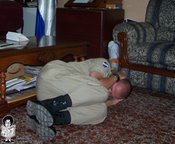
2) Cats, dogs and babies often naturally curl up in the fetal position. You should too in an earthquake. It is a natural safety/survival instinct. That position helps you survive in a smaller void. Get next to an object, next to a sofa, next to a large bulky object that will compress slightly but leave a void next to it.

3) Wooden buildings are the safest type of construction to be in during an earthquake. Wood is flexible and moves with the force of the earthquake. If the wooden building does collapse, large survival voids are created. Also, the wooden building has less concentrated, crushing weight. Brick buildings will break into individual bricks. Bricks will cause many injuries but less squashed bodies than concrete slabs. Concrete slab buildings are the most dangerous during an earthquake.

4) If you are in bed during the night and an earthquake occurs, simply roll off the bed. A safe void will exist around the bed. Hotels can achieve a much greater survival rate in earthquakes, simply by posting a sign on the back of the door of every room telling occupants to lie down on the floor, next to the bottom of the bed during an earthquake.


5) If an earthquake happens and you cannot easily escape by getting out the door or window, then lie down and curl up in the fetal position next to a sofa, or large chair.


6) Almost everyone who gets under a doorway when buildings collapse is killed. How? If you stand under a doorwa y and the doorjamb falls forward or backward you will be crushed by the ceiling above. If the door jam falls sideways you will be cut in half by the doorway. In either case, you will be killed!

7) Never go to the stairs. The stairs have a different 'moment of frequency (they swing separately from the main part of the building). The stairs and remainder of the building continuously bump into each other until structural failure of the stairs takes place. The people who get on stairs before they fail are chopped up by the stair treads? horribly mutilated. Even if the building doesn't collapse, stay away from the stairs. The stairs are a likely part of the building to be damaged. Even if the stairs are not collapsed by the earthquake, they may collapse later when overloaded by fleeing people. They should always be checked for safety, even when the rest of the building is not damaged.

8) Get Near the Outer Walls Of Buildings Or Outside Of Them If Possible - It is much better to be near the outside of the building rather than the interior. The farther inside you are from the outside perimeter of the building the greater the probability that your escape route will be blocked.

9) People inside of their vehicles are crushed when the road above falls in an earthquake and crushes their vehicles; which is exactly what happened with the slabs between the decks of the Nimitz Freeway. The victims of the San Francisco earthquake all stayed inside of their vehicles. They were all killed. They could have easily survived by getting out and lying in the fetal position next to their vehicles. Everyone killed would have survived if they had been able to get out of their cars and sit or lie next to them. All the crushed cars had voids 3 feet high next to them, except for the cars that had columns fall directly across them.


10) I discovered, while crawling inside of collapsed newspaper offices and other offices with a lot of paper, that paper does not compact. Large voids are found surrounding stacks of paper.

In 1996 we made a film, which proved my survival methodology to be correct. The Turkish Federal Government, City of Istanbul , University of Istanbul Case Productions and ARTI cooperated to film this practical, scientific test. We collapsed a school and a home with 20 mannequins inside. Ten mannequins did 'duck and cover,' and ten mannequins I used in my 'triangle of life' survival method. After the simulated earthquake collapse we crawled through the rubble and entered the building to film and document the results.

The film, in which I practiced my survival techniques under directly observable, scientific conditions, relevant to building collapse, showed there would have been zero percent survival for those doing duck and cover.

There would likely have been 100 percent survivability for people using my method of the 'triangle of life.' This film has been seen by millions of viewers on television in Turkey and the rest of Europe , and it was seen in the USA , Canada and Latin America on the TV program Real TV.

Spread the word and save someone's life... The entire world is experiencing natural calamities so be prepared!
©

February 15, 2012

January 24, 2012

Real-time apps, twitters tracking air quality levels in your Chinese city

Greenpeace East Asia
by Monica Tan 2011-10-10 at 11:47

With the rise of China's middle class comes a demand for improved quality of life. So its little wonder air pollution is an ongoing 'hot topic' in Mainland China and Hong Kong, and with it how exactly the government is monitoring air pollution. This week Jonathan Watts of the Guardian covered the recent inclusion of tiny particulate matter PM2.5 in the government's list of air quality indicators, a move sure to gain the approval of environmentalists.

Until now, [PM2.5's] absence from the national pollution index created an absurd discrepancy between official claims of "blue sky" conditions and the reality of air so putrid and murky it could be tasted. "At present, the public's feelings about air quality are different from the monitoring data," environment vice-minister Zhou Jian acknowledged during a speech at a recent forum. "To prevent haze, we will improve the air quality standards as soon as possible and include PM2.5."

For those living in China, we've compiled a list of real-time updated air pollution tracking sites, micro-blogs and apps. They'll help you closely monitor the skies (and know to stay indoors on those 'crazy bad' days):

Across China

http://58.68.130.147/air/
From China's National Environmental Monitoring Center (CNEMC), covering 113 major Chinese cities, in Chinese. Click through the first three slides to reach the real-time, hourly updates. Read Angel Hsu's post for an analysis of this data. (via Vance Wagner)

http://y234.cn/?page_id=5121
From a Chinese graduate student in astronomy, covering Chinese capital cities, in Chinese. Has comparisons between Chinese government standards with those from the US/Canada.

East Asia

http://www.amfic.eu/bulletin/index.php
Air Quality Monitoring and Forecasting in China provides daily air quality bulletins as 'heat maps' for Beijing, Shanghai, Shenyang, Hong Kong, Qingdao and Seoul, in English and Chinese. As well as a high-level map covering the entire East Asia region. The air quality indicators are separated into dedicated maps.

Hong Kong

http://www.greenpeace.org/eastasia/campaigns/air-pollution/work/
Greenpeace have published an application that compares air pollution data from all 14 of Hong Kong's monitoring stations to World Health Organization guidelines.

http://hedleyindex.sph.hku.hk/tracker.php
The University of Hong Kong also have an Air Quality Tracker, updated daily, in both English and Chinese. (via Clean Air Network)

Beijing

Twitter: @BeijingAir
From the US embassy in Beijing, reporting PM2.5 and ozone readings. Real-time hourly updates in English (and unofficial re-posting on Weibo.) Head to the US Government's AIRNow site for an explanation to their Air Quality Index.

Application: Beijing Air Quality
An apps designer has turned the US embassy's data into an application for your smartphone. In English and Chinese.

Shanghai

http://www.envir.gov.cn/Eng/Airep/index.asp
The Shanghai Environment Monitoring Center have daily updates in both English, and Chinese.

http://www.sepb.gov.cn/seicroot/english/index.jsp
The Shanghai Environmental Protection Bureau also have daily updates with specific data from different Shanghai districts. Also in Chinese.

Guangzhou

Twitter: @Guangzhou_Air
From the US embassy in Guangzhou, reporting PM2.5 levels twice a day, on weekdays, in English. Head to the US Government's AIRNow site for an explanation to their Air Quality Index.

Have any others?

If you know of other apps, micro-blogs or sites to add to this list send them in via the comments section below!

Air pollution is a severe problem, costing China and Hong Kong billions of dollars each year in lost productivity and health expenses. The most basic solution for air pollution is to end its root causes: quit coal and move away from fossil fuels, replacing them with clean, renewable energy. The solutions to air pollution are straightforward and simple but they require government action: quit coal, establish clear, strict air quality standards, upgrade fuel grade standards and increase urban green spaces.

In order to achieve this Greenpeace are in Hong Kong pushing the government to update its Air Quality Objective and to adopt greater energy efficiency renewable energy standards. While in China we're campaigning against the biggest cause of air pollution – coal.

©

March 4, 2010

Hugo Chavez Blames U.S. For Earthquake In Haiti

There is little doubt that the US and Russia have the capability to cause massive earth movement along with weather modification.

Whether US weapons testing caused the Haiti earthquake may be a bit of a stretch, but it is a possibility.

At this point, Chavez should offer us some sort of proof.

Venezuelan leader Hugo Chavez has once again accused the United States of playing God. But this time it’s Haiti’s disastrous earthquake that he thinks the U.S. was behind. Spanish newspaper ABC quotes Chavez as saying that the U.S. navy launched a weapon capable of inducing a powerful earthquake off the shore of Haiti. He adds that this time it was only a drill and the final target is … destroying and taking over Iran.

Grant Lawrence
January 21, 2010
©

Magnitude-6.4 earthquake rattles southern Taiwan

TAIPEI, Taiwan -- An earthquake measuring 6.4 on the Richter scale struck southern Taiwan at around 8: 18 a.m. Thursday, the Seismology Center under the Central Weather Bureau reported later that day.

Except that a fire broke out in Chiayi City and a man was injured by a falling tree in Chiayi County, no other casualties or damage had been reported as of the press time.The quake, centered 17 km southeast of Jiasian in Kaohsiung County, southern Taiwan at a depth of 5 km, was felt around the island, seismologists said.

The quake had an intensity of 6 in Nansi in Tainan County and Dapu in Chiayi County, 5 in Taoyuan in Kaohsiung County, Chiayi City and Douliou in Yunlin County.


February 27, 2010

Taipei temperatures shoot up to record high of 31.8 degrees

TAIPEI, Taiwan -- Temperatures in Taipei City shot up to 31.8 degrees Celsius Friday, a record high for the city in the month of February, according to the Central Weather Bureau (CWB).

The last time Taipei experienced a similarly hot February day was on Feb. 23, 1979, when the mercury hit 31.4 C, the CWB said.

Temperatures were high around the island Friday, climbing to 32.9 C in Dawu, Taitung County, at around noon.

The warm weather there was attributed to foehn winds, a warm dry wind that occurs on the leeward slopes of a ridge of mountains after the air mass has released its moisture on the windward slope.

Other areas around Taiwan that also witnessed high temperatures Friday included Keelung in the north (30.5 C) , Chiayi in the south (30.2 C), and Taichung in central Taiwan (30.1 C), CWB reported.
©

December 20, 2009

Year's biggest, Richter scale 6.8, quake strikes Taiwan

Year's biggest, Richter scale 6.8, quake strikes Taiwan - The China Post

TAIPEI, Taiwan -- A Richter scale 6.8 earthquake shook much of Taiwan at 9:02 p.m. yesterday, the biggest tremor to strike the island so far this year, the Central Weather Bureau reported.

The epicenter of the quake was 25 kilometers southeast offshore the eastern city of Hualien, striking at a depth of 44.6 kilometers.

Buildings were shaking for about 20 seconds as far away as the capital Taipei in the northern part of the island.

In the city of Hualien a number of minor incidents were reported in the minutes after the quake.

“There were gas leaks and minor fires and people trapped in elevators,” an official at the Hualien fire department said.

The fire department also said three people had sought medical help after feeling unwell due to the leakage of an unidentified substance.

Local TV reported that some Hualien residents were injured by falling rocks, and that windows were blown out in a Hualien hotel, with guests rushing out of the hotel in panic.

Local TV reported that a high-speed railway linking Taipei to the southern city of Kaohsiung had been suspended as a safety precaution.

But the mass raid transit systems in Taipei resumed operations at 9:19 p.m. after 17 minutes of suspension.

There were also TV reports of interruptions in the power supply in a northern district of Taipei.

At least four people in the capital had minor injuries, most resulting from falling water towers from the roofs of buildings, some cars were also damaged by the falling water towers.

Earthquakes frequently rattle Taiwan but most are minor and cause little or no damage.

However, a 7.6-magnitude earthquake in central Taiwan in 1999 killed more than 2,300 people.

And in 2006 a 6.7-magnitude tremor south of Kaohsiung severed undersea cables and disrupted telephone and Internet service to millions throughout Asia.


© © © ©

August 11, 2009

Taiwan's Typhoon Terror

Photo Essays - TIME

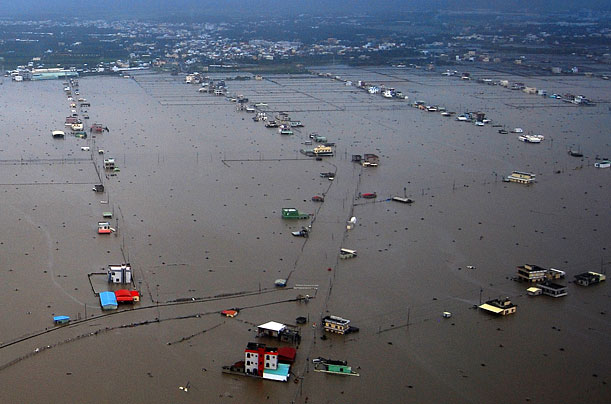
Typhoon Morakot, the worst storm to hit Taiwan in 50 years, swamped the island with 83 in. of rain on Aug. 7 and 8 before slamming the mainland Chinese coast, where a million people were evacuated. Fewer than 20 people have been reported killed.

Floodwater from the typhoon caused severe damage to the Hotel Chin Shuai in Chihpen in southeastern Taiwan's Taitung county.


STR / AFP / Getty Images

Typhoon Morakot's destructive strength damaged a bridge linking the cities of Pingtung and Kaohsiung in southern Taiwan.


Sam Yeh / AFP / Getty

An Aug. 10 government photo shows the extent of flooding caused by the typhoon in southern Taiwan.


AFP / Getty Images

©